
The multi-year project included Prime Vision’s data management, a sorting decision platform, and analytics modules, resulting in more flexible, dynamic, and efficient operations across the network. From the beginning, both companies agreed that such an ambitious transformation could only succeed through a strategic partnership built on transparency and close collaboration.
Posti’s Janne Remesaho, Head of Sorting Technology, and Jari Perälä, Director of Operations and Network Strategy, reflected on the impact of the project, the operational changes it delivered, and the collaboration with Prime Vision.
A modernization vision brought to life
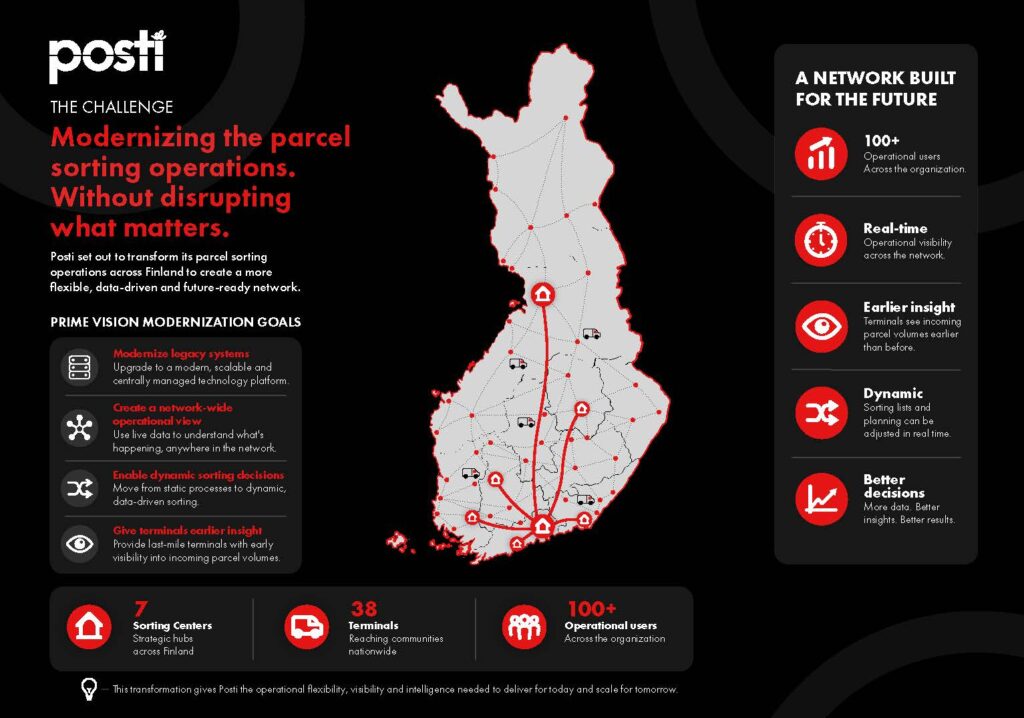
Posti’s modernization goals focused on three key areas, explains Janne Remesaho: upgrading the legacy system to current technological standards, creating a network-wide operational view, and enabling dynamic handling of sorting lists. While the first goal represented a technical transformation, the network view and sorting-list management delivered major strategic advantages.
Prime Vision’s data management module became the foundation of the overall network view. According to Janne and Jari, significantly more operational data is now actively used across the organization.
“We already had business intelligence reports, but they were not based on live information. With the new network view, we can now use all of the data and see what is happening in real time.”
The completed network view allows Posti to plan sortation at network level, implement product changes across all operations, and give last-mile terminals insight into incoming parcel volumes much earlier in the process.
“Previously, planning was usually based on forecasts. Now terminals can prepare and organize their daily work using live operational information. That has been a major change.”
The project also transformed the handling of sorting lists.
“Earlier, this process was still quite static. Today, we can manage sorting lists much more dynamically.”
Collaboration across multiple levels
The implementation of the new platform significantly expanded the number of employees working with the system. Where previously only around a dozen people interacted with the planning environment daily, the new solution now supports hundreds of operational users across the organization.
“This demonstrates how much we trusted the solution and the collaboration,” says Janne.
The project demanded close cooperation between operational experts, developers, and UX designers from both companies. Considerable effort was invested in creating an intuitive user experience that could support users throughout the organization.
Prime Vision implemented data management, a sorting decision platform, and analytics modules. These building blocks now support operational planning of the sorting process, sorting-plan simulations, machine integrations, operational monitoring, and business intelligence analysis for better-informed decision-making.
The platform combines proven functionality already operational at several postal and CEP organizations across Europe with newly developed capabilities as well as components tailored specifically to Posti’s operational requirements. Throughout the project, Prime Vision and Posti jointly developed and implemented new roadmap features and customer-specific functionality.
Delivering business value
A significant part of the project focused on translating user stories into practical operational value. Key questions guided the development process:
- Can administrators easily adapt system configurations and sorting logic?
- Can legacy systems and existing processes be integrated smoothly?
- Can the platform support both local and central sorting functionalities efficiently?
Prime Vision evaluated each requirement carefully, determining whether it could be addressed through existing product modules or whether new tailored development was needed.
Given the complexity and long-term nature of the transformation, both organizations recognized the importance of thorough decision-making, continuous alignment, and open communication. This strategic partnership proved essential to the success of the project.
For Posti, the implementation represented far more than a software upgrade.
“This was not only the implementation of new software, but also a completely new way of working, from the local sorting centers to the last-mile terminals,” says Jari.
The collaboration also created value for Prime Vision. The experience and learnings from the project contributed to further strengthening and evolving the company’s solutions for future customers.
The solution is also available through a Sorting-as-a-Service model, enabling access to additional capacity without capital investment.
A new approach to peak capacity
Although the Finnish and Dutch teams had collaborated before, the scale and importance of this project required a much deeper level of cooperation.
“The contact had to become much more intensive in a project of this size,” says Janne. “We were working together at a much deeper level, and that was necessary.”
The partnership was built on openness and mutual trust.
“We wanted Prime Vision to challenge us when needed and take responsibility together with us throughout the entire process, from requirements and development to testing and implementation.”
Jari adds:
“Sometimes it is important to hear: ‘Are you sure this is the best solution? We may have a better idea.’ That reflection and coaching in both directions is the true meaning of a strategic partnership.”
Setting a new industry standard
Although the Finnish and Dutch teams had collaborated before, the scale and importance of this project required a much deeper level of cooperation.
“The contact had to become much more intensive in a project of this size,” says Janne. “We were working together at a much deeper level, and that was necessary.”
The partnership was built on openness and mutual trust.


